After the May half-term break, the most noticeable change isn’t simply that “the holiday is over”; it’s that children will keep talking about what happened during those few days for a long time afterward. They don’t just give a vague “it was fun”; they share specific details—the shifting moods of the ponies, a particular stretch of the woodland trail, hands still trembling after a rollercoaster ride, or that moment of hesitation when they got stuck on a high-ropes course.
These memories remain so vivid because PGL’s May Half-Term Specialist Camps are designed around “interest immersion” rather than just a random assortment of activities.
Pony Riding Camp: The real transformation happens before the actual riding begins
The most interesting aspect of the pony riding camp isn’t the riding itself, but the clearly visible journey from “not knowing how” to “beginning to understand.”
When the children first arrive at the stables, there is a palpable sense of distance. It isn’t necessarily fear; they might stand back and observe for a long time, unsure of how to approach the animals. Instead of rushing them straight into the saddle, the instructors start with something that seems basic: observing the pony’s state.
They look at things like the direction of the ears, the swishing of the tail, and the rhythm of the movement. While these details might seem minor to adults, for children, it is often their first realization that “animals communicate.” Later, when they get home, the thing they mention most often isn’t “I rode a pony,” but rather, “I realized ponies don’t always act the same way.”
(1) The transition from “sitting in the saddle” to “controlling the rhythm”
When they move to the second stage—actually getting on the pony—their physical reactions are genuine: nervousness, stiffness, and an instinctive tendency to grip the reins too tightly. The initial goal isn’t to control the pony, but simply to learn how to stay balanced and not fall off.
However, they soon reach a turning point—not necessarily through improved technique, but through an emerging understanding of rhythm. They learn, for instance, that they must move their bodies in sync when the pony speeds up, and that when turning, they shouldn’t fight against the movement but rather adjust to flow with it.
One telling piece of feedback comes from children who say, “If I use too much force, the pony actually stops listening to me.” This realization is far more important than the mechanics of the riding itself.
In PGL’s program design, this phase is less about teaching riding skills and more about building an awareness of body control.
(2) Trail Riding: Realizing It’s Not Just a “Training Arena”
Moving to the trail riding phase significantly elevates the experience due to the change in environment.
Instead of a fixed arena, the route winds through a mix of woods, narrow paths, and open meadows. One section involves a slight uphill turn; when describing it later, the child was very specific: “The horse slows down a bit on that slope on its own—it’s like it knows the way.”
The key at this stage isn’t speed, but judgment and trust. Children begin to realize that the horse isn’t under total control but possesses a degree of autonomy, and the rider’s role is to work in partnership with the animal.
For many, this is the moment “horseback riding” shifts from a mere physical activity into a genuine, immersive experience.
(3) Stable Care: Interest Evolves into “Responsibility”
The final stable care session might initially look like a “wrap-up task,” but it often proves to be one of the most memorable parts of the program.
Feeding, cleaning tack, and tidying up the area aren’t complex tasks, yet children start noticing details—such as how different horses eat at different speeds or how some dislike being touched in certain spots. These observations naturally lead to a deeper understanding of animal behavior.
A telling shift occurs when children start asking, “Will I have the same horse tomorrow?” rather than simply, “Are we riding again tomorrow?”
In designing this segment, PGL effectively extends the child’s interest from a mere “activity” to a meaningful “relationship.”
Theme Park Adrenaline Breaks: “Contrast-Based Learning” After the Thrill
The theme park experience is straightforward: pure, unadulterated excitement.
Upon entering the park, there is little sense of “learning”—just the cycle of queuing, riding rollercoasters, and hopping off to debate which ride was faster or taller. A common state of mind emerges: despite being exhausted, the child still wants to go again.
However, the real shift happens back at camp.
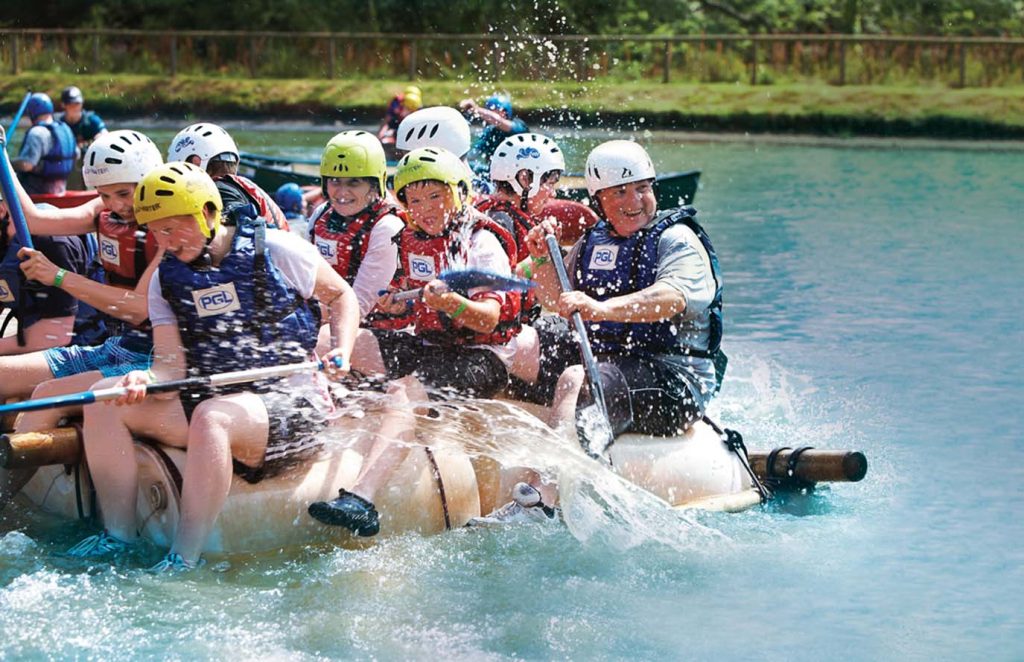
Activities like high ropes courses and whitewater challenges don’t just keep the adrenaline pumping; they shift the focus to “control.” On the ropes course, it’s not about rushing forward but assessing where to step; in the rapids, it’s not about crashing through, but maintaining stability and coordination.
Children clearly sense the difference: “At the park, you’re just taken along for the ride; at camp, you have to figure out the path yourself.”
v’s structure here is clear: first, push the body to its limits, then allow the mind to process and make sense of that experience.
An easily overlooked point: the way children interact has changed
Beyond the activities themselves, there is a subtle yet significant shift in how the children communicate with one another.
In the horse-riding group, they might discuss whose horse is faster or who is better at controlling the pace; in the theme park group, they talk about which ride is the most thrilling or which one they want to tackle next.
More importantly, however, they have shifted from simply asking “Is it fun?” to sharing descriptions of their experiences. This change in expression lies at the very heart of the transformation.
A sense of security stems from structure, not from constant reminders about safety
A subtle yet crucial aspect of the PGL system is that a sense of security isn’t created by constantly emphasizing safety, but rather arises naturally from the structure itself.
For instance, horse riding follows a set procedure at every stage, high-ropes courses have clear safety-check protocols, and all activities feature tiered difficulty levels. Children aren’t constantly told to “be safe,” yet they naturally find themselves in an environment with clear boundaries.
Paradoxically, this approach actually helps children feel more at ease.
PGL’s selection approach: Interest matters more than age
PGL’s Specialist Camps clearly prioritize interests—such as choosing a horse-riding or theme-park track—over simply grouping children by age.
A key takeaway from this experience is that when a camp is chosen based on a child’s interests, their level of engagement is completely different.
What truly endures isn’t the list of activities, but specific, vivid memories
Looking back at the experience, what stands out most clearly isn’t the itinerary, but rather a series of small, distinct moments:
The movement of the horses’ ears, the slope of the trail during the woodland ride, the instant they truly mastered controlling the horse’s pace, hands still trembling after getting off a roller coaster, and that single step taken after a moment of hesitation on the ropes course.
Ultimately, PGL’s May Half-Term Specialist Camps are not merely a collection of activities; they transform an interest into a complete, memorable experience.